
Managing arthritis pain
What does arthritis pain feel like?
Arthritis is a term that’s used for conditions that cause pain, swelling and stiffness in 1 or more joints. Arthritis pain is sometimes described as a dull ache, painful pins and needles, intense soreness, stabbing or shooting pain, or a burning feeling. It might be confined to 1 or 2 joints, or it may be more widespread.
Pain from arthritis can be short-term or chronic. Your pain may come and go. It’s likely to get better and worse over time.
Key facts
|
If you go through a period when your pain and other symptoms are greatly reduced, it’s known as remission. With the right treatments, you may achieve remission. But this does not mean your arthritis is cured. Most forms of arthritis are lifelong.
Periods of time when pain and other symptoms are worse than usual are known as ‘flare-ups’, ‘flares’ or ‘attacks’.
Your arthritis symptoms may be made worse by changes in the weather. Some people find extreme heat causes them extra pain, while others get painful joints when it’s cold or damp outside. Joints affected by arthritis can also be very sensitive to touch.
What your pain feels like – and the most effective ways to manage it – will depend on:
- which type of arthritis you have
- how severe your arthritis symptoms are
- how well managed your arthritis is at the time.
Some medications that are used to manage arthritis symptoms can create side effects that may cause you discomfort.
What is pain?
Pain is meant to protect you. Your nervous system can produce pain in response to injury, encouraging you to protect the affected area while it heals. But pain is not always protective. In inflammatory arthritis, an overactive immune system can cause pain even when there is no injury. Pain can also continue because of changes in the nerves and nervous system.
When pain lasts for longer than 3 months, it’s referred to as chronic pain. It can have emotional effects, especially if the cause of your pain is unclear or if it’s hard to find pain relief that works.
Treating arthritis pain
It might take several attempts to find treatments that work for you – with the fewest side effects – but many people find approaches that help them to manage their arthritis symptoms. While you may not be completely free from pain, the aim should be to reduce your pain to a level that you can cope with.
The nature of your pain, and how it affects you, will be a very personal thing. And the best treatments for your condition will depend on a lot of factors, not least the type of arthritis you've been diagnosed with.
It may not be possible for you to live a life that’s pain free, but your healthcare team should work with you to assess and reduce your pain levels as much as possible.
Pain relief for osteoarthritis
Osteoarthritis is the most common form of arthritis. It can cause pain in 1 or more joints. Your pain may be accompanied by crunching or swelling and stiffness, and your joints may lock. The pain can be worse in the morning, or after you’ve stayed still for a while. Osteoarthritis pain can be mild or more severe.
You may feel you can manage your pain without drug treatments. Exercise is one of the best ways to manage osteoarthritis. It can help reduce pain and improve how well your joints work. Easing the strain on your joints by adapting activities and using aids such as a walking stick for a while can help when your pain is at its worst.
If you need to use pain relief medication, your GP may suggest you try:
- anti-inflammatory medicines (NSAIDs) in the form of gels, creams or tablets
- capsaicin cream
- a steroid injection to provide short-term pain relief in a joint if other methods of pain relief are not helping
- antidepressant drugs such as duloxetine and amitriptyline may help if pain is disrupting your sleep.
There is not much evidence to suggest that pain relief medicines such as paracetamol or codeine help with osteoarthritis pain.
If you've tried all other methods of pain management and you’re still in severe pain, you may be offered surgery on a joint. Not everyone with osteoarthritis will need to have surgery. And it is not suitable for everyone.
Related information
Pain relief for inflammatory arthritis
Inflammatory arthritis is a systemic condition. This means it can affect the whole body. There are several types of inflammatory arthritis and they do not all cause the same symptoms. If you have inflammatory arthritis, your pain is likely to be widespread, affecting more than your joints.
The most common forms of inflammatory arthritis are:
Further gout informationGout is a form of inflammatory arthritis where uric acid crystals form in the joints. It's intensely painful and can lead to flare-ups, known as attacks. Treatment for gout is not the same as treatment for other forms of inflammatory arthritis. During a gout attack, you will need to take either: NSAIDs can be very effective pain relief for gout attacks. You can take them along with colchicine or steroids, if you need to. But often, 1 form of medication works well enough on its own to bring a gout attack under control. You may also wish to wrap an ice pack in a tea towel and place it on painful joints. You will then be offered treatment to help prevent gout attacks in the future. Your GP will explain the risks and benefits. Find out more about gout |
Pain from inflammatory arthritis does not always mean your treatments are not working. You can get ongoing pain and flare-ups even if your condition is well managed.
Your healthcare team will review your pain levels with you at your appointments to ensure you’re still on the best treatments for you. You may need to take more than 1 drug at a time because different drugs help in different ways. You may also need to alter which drugs you take if your condition changes.
Disease-modifying anti-rheumatic drugs (DMARDs) are usually one of the first treatments you’ll be offered. They’re not a form of pain relief, but they reduce the inflammation that contributes to pain, and can help prevent damage to your joints and organs. If DMARDs do not help, or do not suit you, biologics (bDMARDs) or janus kinase inhibitors (JAK inhibitors) may be offered to you as well or instead.
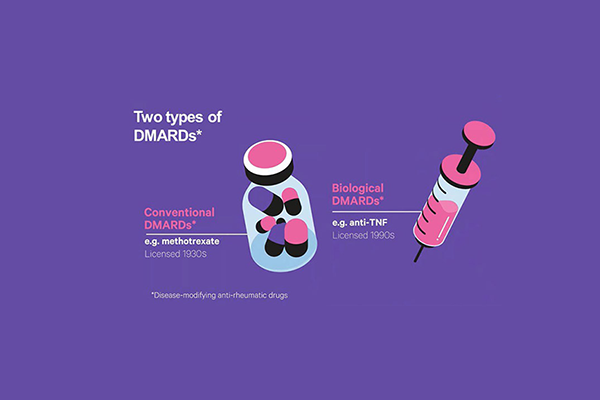
DMARDs: Your questions answered
Disease-modifying anti-rheumatic drugs (DMARDs) can treat the underlying cause of your condition and reduce inflammation. They're given to people with autoimmune conditions, such as rheumatoid arthritis, psoriatic arthritis and lupus. DMARDs can improve symptoms such as pain, stiffness and swelling.
For most forms of inflammatory arthritis, DMARDs combined with pain relief or NSAIDs that you buy over the counter can help with the pain. Prescription-strength NSAIDs such as naproxen, or prescribed pain relief such as codeine, can help for short periods if you need something stronger during a flare-up.
Steroids may be offered to help with bad pain during a flare-up or while you wait for DMARDs to start working. In some cases, long-term steroid treatment may be advised, but this is only offered if other pain management methods have not worked.
In some cases, surgery can reduce pain caused by inflammatory arthritis, correct the shape of a joint, or improve mobility.
The emotional impact of pain
Pain makes all aspects of your life more of a challenge. At its worst, pain might affect your ability to:
- Do your job
- Get a good night’s sleep
- Play with your children
- Manage around the house
- Maintain an active social life
- Engage in your hobbies.
You may be tempted to avoid doing things that might increase your pain, or you may stop doing things you enjoy because of the worry around pain. This can impact on your mood.
If your pain is affecting your mental health, it can help to tell someone how you’re feeling. Accept help from people around you if they offer it – and do not be afraid to admit that you need further support. Make sure your healthcare team is aware that pain is getting you down, if that’s the case, too. They can review how it’s affecting you and help you put a plan in place to manage it.
The NHS offers talking therapies, which give you a safe space to discuss how your condition is affecting you. In a lot of places, you can refer yourself without seeing a GP first, but this does vary by area.
These useful websites aim to help people live well with pain:
What else can help with arthritis pain?
Many people find that medication on its own is not enough to help with their pain. The approaches in this section can be used along with drug treatments to reduce your arthritis pain further.
Keeping active
Your instinct is likely to be to try and protect whichever part of your body is painful. This can lead to pain limiting what you do. But exercise is unlikely to cause you damage. It may even help with your pain over time. That’s because it can:
- Improve your muscle strength, which keeps your joints strong and supported
- Stretch tight muscles
- Reduce stiffness
- Increase energy levels
- Help you keep to a healthy weight, which will reduce strain on your joints
- Boost your mood.
It’s better to do a little bit of activity more often, rather than doing too much on one day and needing to take a long time to recover from it.
For more information about staying active with arthritis, Arthritis UK has a booklet called Keep Moving. You can also try these online exercise classes that are designed for people with arthritis:
These exercises are for people who have pain in specific joints:
Physiotherapy
Physiotherapy involves movement, manipulation of muscles and joints, education and advice to help ease your pain and get your muscles and joints moving more easily. It’s particularly helpful for people who have osteoarthritis.
A physiotherapist may also offer guided exercise – stretches, or specialised Pilates or yoga programmes – designed for people with musculoskeletal issues like arthritis.
If you’re thinking about trying a TENS machine for your pain, a physiotherapist can show you how to use it. You may be able to borrow one from them for a while.
In many areas, you can self-refer to a physiotherapist. Find out more about physiotherapy.
Pain management programmes
Pain management programmes help you learn about living with pain. Topics may include:
- Pacing yourself
- Managing flare-ups
- Getting better sleep
- Coping with the impact of pain on your daily life.
Specialist pain services or pain clinics can assess more complex pain and work with you to find ways to manage it. Your healthcare team can advise whether referral to a specialist pain service may be helpful.

Join our free online information session: Managing pain
Pain is one of the most common symptoms of arthritis, and these Health Information sessions will help you understand the difference between acute and chronic pain. Being able to understand your pain and communicate this to family, friends, healthcare professionals and employers can make a big difference to your condition.
Looking after painful joints
As well as pain relief medications, there are other ways to ease pain, reduce stiffness and make everyday activities more comfortable if your joints hurt.
These small changes can make life easier until your pain improves:
- Choosing supportive footwear
- Using handy tools and gadgets around the house
- Adapting tasks
Some people find that applying warmth to stiff muscles and joints helps them relax and move more easily, while a cold pack can help soothe hot, swollen joints. You may find one method works better for you, or that you prefer to use different approaches at different times.
If you've been advised to use splints or supports when your pain is bad, follow the guidance you've been given. They can help support painful joints to allow you to continue with daily activities. But prolonged use may weaken the muscles around the joint.
Complementary and alternative treatments
There is little evidence to support the use of complementary therapies for arthritis, but some people find they help with their pain.
There are some risks associated with specific therapies. For example, herbal supplements may interact with prescribed medication, so you should always talk to your doctor before you try a treatment.
Complementary treatments are rarely offered on the NHS. If you choose to see a therapist, look for one who is registered with an appropriate professional body, follows a code of ethics and is fully insured.
Find out more about living well with arthritis.
Discover our support services
You don’t need to face arthritis alone. Get the information, advice and support that you need.
- Call our free helpline: 0800 5200 502
- Connect with our online community
- Chat with AVA our online assistant
- Track your symptoms with our easy app
Managing arthritis pain
Ease arthritis pain with the Hot-Pak® wrap. Heat in the microwave to enjoy the Hot-Pak's soothing warmth and gentle French lavender scent. Choose your favourite design.
Shop hot packDesigned by a hand therapist and thoroughly patient tested, we know that tired, achy hands can benefit greatly from the gentle compression and support provided by these gloves.
Shop compression glovesThese plush Warmies® Boots are the perfect gift for everyone. Simply warm them in a microwave to experience the ultimate comfort and relaxation, or chill them in the freezer for cooling relief.
Shop Warmies bootsSources
Key clinical guidance
- Scott I et al., The 2026 British Society for Rheumatology guideline for pain management in people with inflammatory arthritis, Rheumatology, Volume 65, Issue 7, July 2026, keag320
- National Institute for Health and Care Excellence (2022) Osteoarthritis in over 16s: diagnosis and management, NICE guideline NG226.[Accessed September 2026]
- National Institute for Health and Care Excellence (2020) Rheumatoid arthritis in adults: management, NICE guideline NG100 [Accessed August 2026]
- National Institute for Health and Care Excellence (2021) Chronic pain (primary and secondary) in over 16s: assessment of all chronic pain and management of chronic primary pain, NICE guideline NG193 [Accessed September 2026]
- National Institute for Health and Care Excellence (2022) Gout: diagnosis and management, NICE guideline NG219
Supporting sources
- Alveyn E et al., Trends in remission rates for rheumatoid arthritis in England and Wales: a population-level cohort study, Rheumatology, Volume 64, Issue 9, September 2025, Pages 4957–4967
- Birkinshaw H, et al., Antidepressants for pain management in adults with chronic pain: a network meta-analysis. Cochrane Database Syst Rev. 2023 May 10;5(5):CD014682. doi: 10.1002/14651858.
- IASP (2022) IASP Revises Its Definition of Pain for the First Time Since 1979 [Accessed September 2026]
- Leite, B. et al., Efficacy and Safety of Duloxetine for the Treatment of Osteoarthritis: Systematic Review and Meta-Analysis, International Journal of Clinical Practice, 2025, 4976407, 16 pages, 2025
- NHS (2025) Physiotherapy [Accessed: July 2025]
- NHS (2023) Overview: Rheumatoid arthritis. [Accessed: August 2026]
- NHS (2023) 10 ways to reduce to reduce pain [Accessed: August 2026]
- NICE (2026) NICE CKS: DMARDs [Accessed July 2026]
- NICE (2025) Chronic pain [Accessed August 2026]
- NICE (2023) Osteoarthritis: Scenario: Management [Accessed August 2026]
Last review date: August 2026
Next review date: August 2028

You can trust our health information
Our information is PIF TICK certified. This means that it’s trusted, evidence-based and accessible.